
Building AI That Ships: Why the Type of AI You Build Determines How You Deliver It
[ SIGNAL SERIES // POST 01 OF 08 // AI & AUTOMATION ]
Most enterprise AI programs fail not because of bad models — but because teams build the wrong type of AI system the wrong way. This eight-part series maps each of the seven AI project pattern types to the real delivery stack, governance requirements, and program management discipline that makes each one survivable in production.
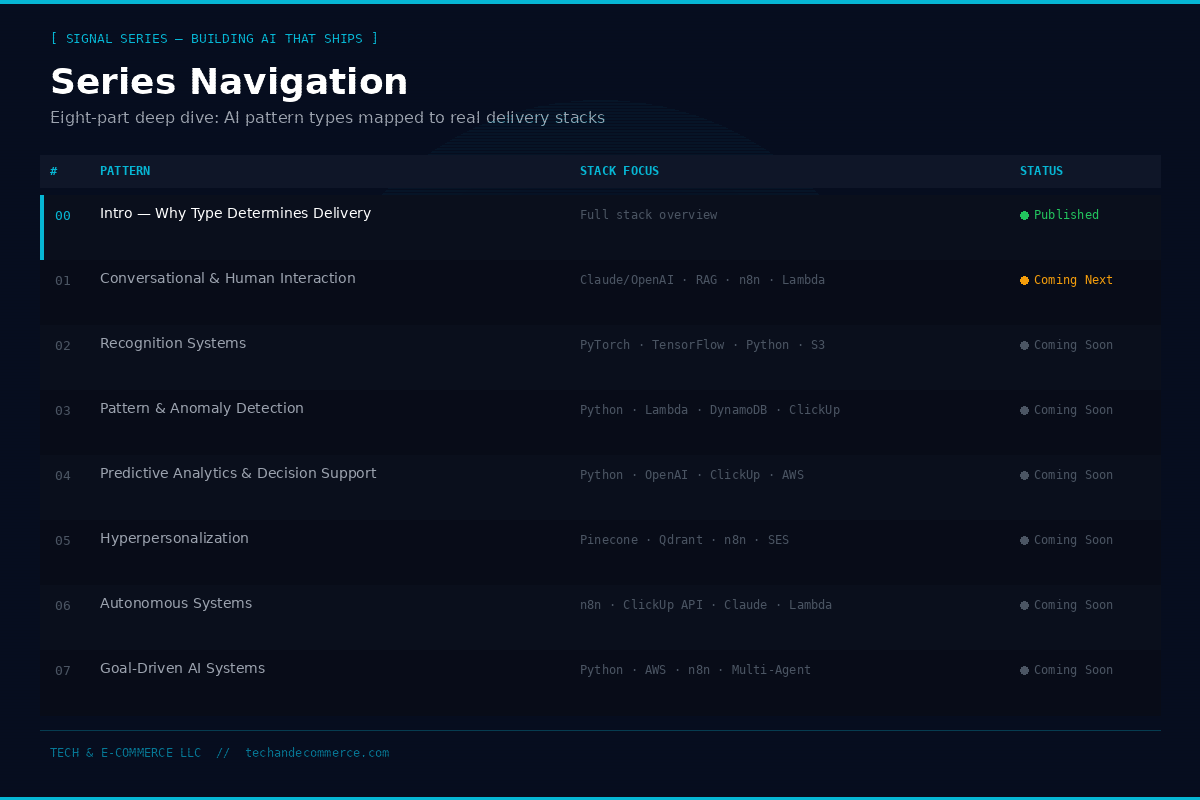
Series Navigation
This post is the foundation of an eight-part series. Each subsequent post goes deep on one AI project pattern type — grounded in the real delivery stack used across past and current Tech & E-Commerce LLC engagements.
The Problem With How Enterprises Build AI
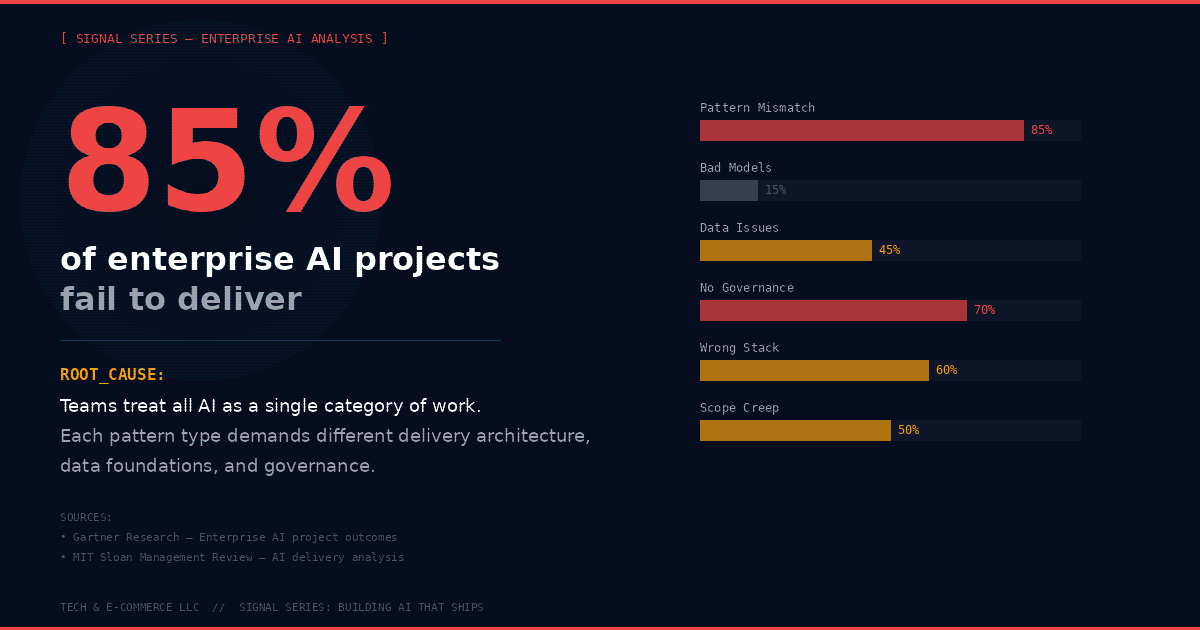
The enterprise AI failure rate is not a technology problem. Research from Gartner documents that approximately 85% of AI projects fail to deliver on their original business objectives. MIT Sloan Management Review analysis shows that the majority of AI project delays trace back not to model performance, but to misaligned problem framing in the earliest stages of delivery.
The root cause is consistent: teams treat AI as a single category of work. A chatbot, a fraud detection engine, a supply chain optimizer, and a computer vision quality system are treated as variations of the same project type — differentiated only by domain. They are not. Each belongs to a distinct pattern type, each demanding different data foundations, different governance, and a fundamentally different delivery architecture.
[ SERIES_NAVIGATION_ ]
Intro — Why Type Determines Delivery
Conversational & Human Interaction
Recognition Systems
Pattern & Anomaly Detection
Predictive Analytics & Decision Support
Hyperpersonalization
Autonomous Systems
Goal-Driven AI Systems
Ready to engage?
Let's discuss how these patterns apply to your next project.
[ INITIATE_ENGAGEMENT_ ]