
From Prompt to Production: Architecting LLM-Powered Conversational Systems That Don't Hallucinate in the Wild
[ SIGNAL SERIES // PATTERN 01 OF 07 // AI & AUTOMATION ]
Building a conversational interface that works in a demo takes an afternoon. Building one that your enterprise can stake its reputation on takes a fundamentally different approach — one that starts well before the first API call is made.
The Production Reality — By the Numbers
| Metric | Value | Source |
|---|---|---|
| AI chatbots pulled back due to hallucination errors (2024) | 39% | IBM AI Adoption Index / Customer Experience Assoc. |
| Average hallucination rate in enterprise chatbot deployments | 18% | SQ Magazine LLM Statistics, 2026 |
| Hallucination rate in retrieval-grounded RAG tasks | <2% | OpenAI Evals / SQ Magazine, 2025 |
| LLM-deploying enterprises now using RAG | 70% | Databricks State of AI, 2024 |
What the Conversational Pattern Actually Is
The Conversational & Human Interaction pattern covers every system where a language model must understand intent, retrieve or generate a relevant response, and deliver it in natural language — whether through text, structured output, or voice. It is the most widely deployed of the seven pattern types and also the most frequently misarchitected.
The reason is deceptively simple: it is the easiest to demo. Every engineer with an API key can build something impressive in an afternoon. The gap between that demo and a production-grade system — one that handles edge cases, uncertain inputs, out-of-scope queries, and real users behaving unpredictably — is where the architectural discipline lives.
The failure mode is always the same: the team treats the conversational interface as a chatbot project. It is not. It is a knowledge infrastructure and governance project that happens to have a natural language front end. The moment the team treats it as the former, the latter gets skipped — and that is what shows up in production.
— Tarek Mollah, Technical Program Consultant, Tech & E-Commerce LLC
Naive LLM vs Production RAG Architecture
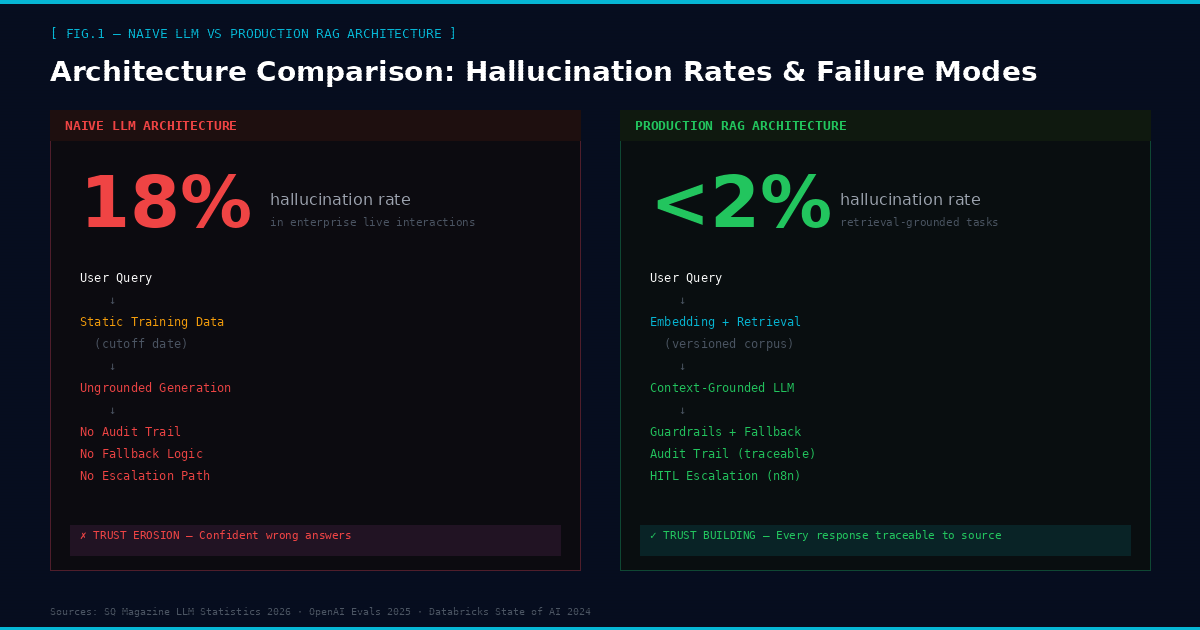
The most critical architectural decision in any conversational project is made before a single line of code is written — whether the system will be grounded in a retrieved knowledge base or allowed to generate freely from the model’s training data alone.
| Dimension | Naive LLM | Production RAG System |
|---|---|---|
| Knowledge source | Static training data with cutoff date | Dynamic retrieval from versioned, curated document corpus |
| Hallucination rate | ~18% in enterprise live interactions | <2% in retrieval-grounded tasks (OpenAI Evals, 2025) |
| Out-of-scope handling | Generates plausible but wrong answer | Deterministic fallback — acknowledges boundary, escalates |
| Knowledge updates | Requires model retraining or fine-tuning | Update the knowledge base — no model change required |
| Audit trail | None — generation is opaque | Every response traceable to source document and retrieval query |
| Context management | Single-turn or stateless by default | Session state in DynamoDB — multi-turn awareness |
| Human escalation | Not designed in | HITL gate via n8n — routes to ClickUp task on threshold breach |
| Observability | Console output | Token usage, latency, fallback rate tracked in CloudWatch |
External reference: SQ Magazine — LLM Hallucination Statistics 2026 | Databricks State of AI: RAG Adoption Trends
Three Conversational Model Types — One Delivery Framework
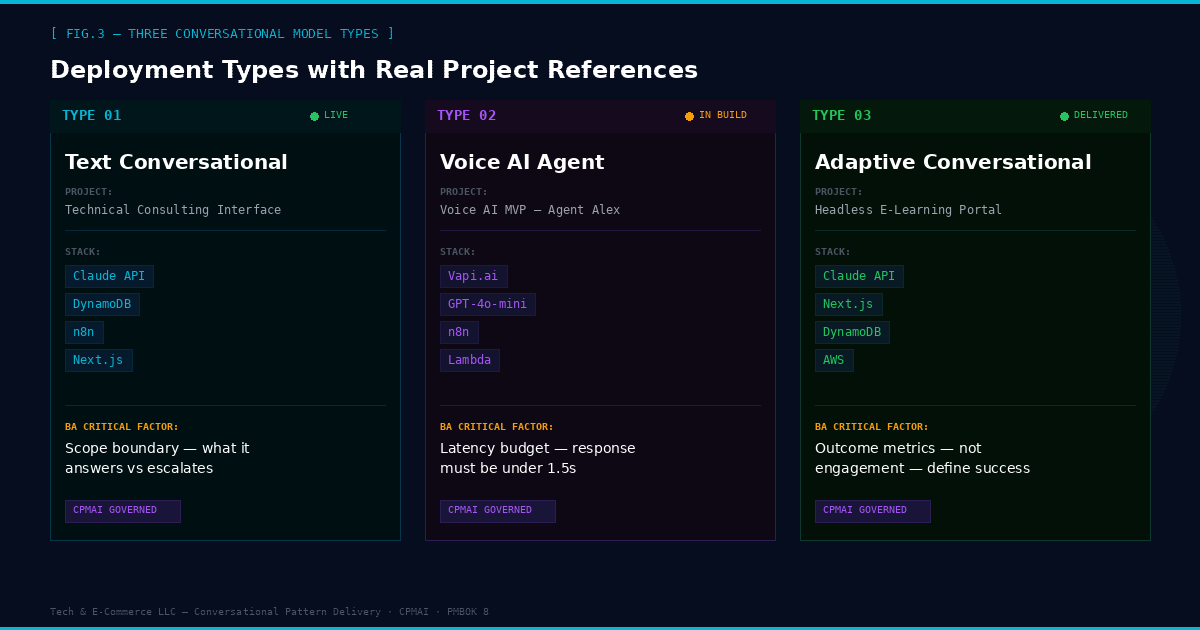
The Conversational pattern manifests in three distinct deployment types. Each demands the same underlying CPMAI delivery discipline, but carries different Business Analysis requirements, latency constraints, and production risk profiles.
| Type | Deployment | Project Reference | Primary Stack | BA Critical Factor |
|---|---|---|---|---|
| 01 | Text Conversational | Technical Consulting Interface — techandecommerce.com (Live) | LLM API · DynamoDB · n8n · Next.js | Scope boundary — what it answers vs escalates |
| 02 | Voice AI Agent | Voice AI MVP — Agent Alex (Innovation Lab — In Build) | Vapi.ai · GPT-4o-mini · n8n · Lambda | Latency budget — response must be under 1.5s |
| 03 | Adaptive Conversational | Headless E-Learning Portal (Delivered) | LLM API · Next.js · DynamoDB · AWS | Outcome metrics — not engagement — define success |
CPMAI Delivery Phases — Applied to Conversational Projects
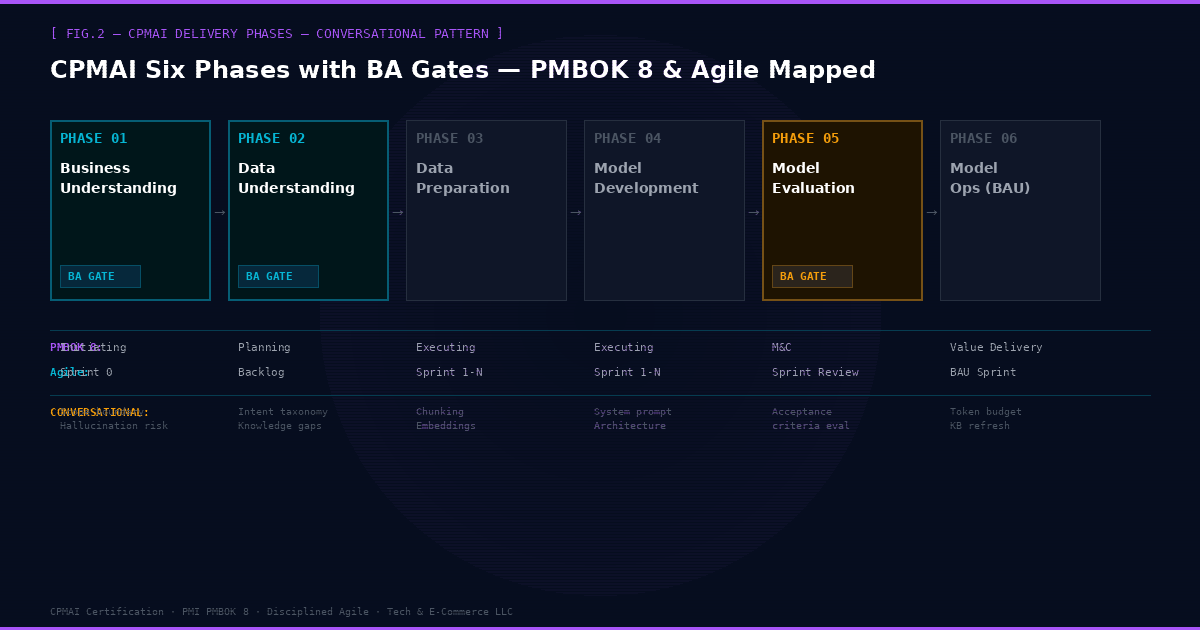
CPMAI defines six phases for structured ML and LLM project delivery. For the Conversational pattern, the Business Analysis layer is non-negotiable at Phases 01, 02, and 05. These are the three phases most frequently compressed or skipped — and the three that determine whether the system survives contact with production users.
Phase 01 — Business Understanding (BA Gate)
Every conversational system failure can be traced to a Business Understanding phase that was either skipped or performed by the engineering team in isolation. The questions that must be answered before Phase 02 begins are not technical — they are business and governance questions that only the right stakeholders can answer.
| BA Deliverable | Why It Matters | Real Example |
|---|---|---|
| Scope boundary definition | Defines what the system answers, escalates, and refuses | Technical Consulting Interface: answers PM and AI delivery questions; escalates project scoping; refuses pricing commitments |
| Hallucination risk acceptance | Business stakeholder must pre-agree on acceptable hallucination rate | E-learning: single factual error in learning content carries different risk than wrong answer in general FAQ |
| Human escalation design | Who receives escalated conversations, through which channel, within what SLA | Voice AI Agent Alex: escalation routes to n8n webhook → ClickUp task → human callback within 2 hours |
| Knowledge base ownership | Who maintains the document corpus, how frequently it is reviewed | Consulting Interface: Tarek owns the knowledge base; quarterly review cycle |
| Success metric definition | Distinguishes between model metrics (accuracy, F1) and business metrics (escalation rate, user return rate) | Adaptive learning: success = improvement in assessed outcomes, not session length |
Phase 02 — Data Understanding (BA Gate)
Data Understanding for conversational systems means knowledge base assessment, not dataset analysis. The questions are: is the document corpus comprehensive enough to ground responses without the model fabricating? Is it accurate? Is it structured for effective retrieval? Are there known gaps that will surface as edge cases in production?
This phase also produces the intent taxonomy — the structured map of what users are likely to ask and how those queries map to knowledge base content. Without it, chunking strategy and retrieval configuration in Phase 03 are guesswork.
The RAG market reached $2.33 billion in 2025 and is projected to grow to $81.51 billion by 2035 at 42.7% CAGR. Enterprises are choosing RAG for 30 to 60 percent of their LLM use cases — driven by the need for grounded, auditable responses over their own proprietary data.
Source: Next Move Strategy Consulting — RAG Market Outlook 2035
Phase 03 — Data Preparation
Data Preparation for conversational systems is knowledge engineering — chunking strategy, embedding model selection, metadata tagging, and vector store configuration. The chunking strategy alone can account for a 15-30% difference in retrieval precision. Chunks that are too large dilute relevance; chunks too small lose context.
At Tech & E-Commerce LLC, the knowledge preparation pipeline is version-controlled in AWS S3 with chunking configuration stored alongside the corpus. Changes to chunking strategy trigger a full re-index — tracked as a ClickUp task and validated in staging before production deployment.
Phase 04 — Model Development (System Prompt Architecture)
System prompt architecture is the most underrated engineering discipline in conversational LLM delivery. It is not a task that takes an hour. It is a versioned, tested, iterated artefact that governs how the model interprets intent, applies retrieved context, handles uncertainty, and respects the scope boundary defined in Phase 01.
For the Technical Consulting Interface on techandecommerce.com, the system prompt encodes: Tarek’s positioning and expertise claims (only what is documented and verified), the scope boundary (what the model can and cannot commit to), the escalation trigger (what signals cause it to offer a direct connection), and the fallback behaviour (what happens when the model is genuinely uncertain).
| System Prompt Layer | What It Governs | Production Failure Without It |
|---|---|---|
| Persona & scope | What the system is, what it knows, what it cannot commit to | Model fabricates capabilities or pricing based on similar patterns in training data |
| Retrieval instruction | How to use retrieved context — when to quote, synthesise, or acknowledge gaps | Model ignores retrieved context and generates from training data — hallucination |
| Uncertainty handling | What to do when confidence is low — acknowledge, offer alternatives, escalate | Confident wrong answer — the most trust-eroding failure mode |
| Escalation triggers | When and how to offer human handoff — threshold signals and phrasing | Model attempts to resolve queries beyond its capability — user frustration |
| Tone and constraints | Register, length norms, prohibited content categories | Off-brand responses or inappropriate content in production |
External reference: OpenAI Platform Documentation
Phase 05 — Model Evaluation (BA Gate)
Evaluation for conversational systems must be governed by the acceptance criteria established in Phase 01 — not by benchmark scores or internal team judgement. The metrics that matter are hallucination rate on domain-specific queries, fallback success rate on out-of-scope inputs, escalation precision, and red team adversarial pass rate.
PMBOK 8 maps this phase to Monitoring and Controlling. The go/no-go decision is owned by the stakeholder who signed off the acceptance criteria in Phase 01 — not by the delivery team. This separation of concerns is what prevents the benchmark accuracy trap.
Phase 06 — Model Operationalization (MLOps / BAU)
Production conversational systems require ongoing governance that most teams do not plan for. Token consumption grows with usage and must be budgeted. The knowledge base becomes stale if not actively maintained. System prompt versions must be tracked to understand which version was live when a production issue occurred.
At Tech & E-Commerce LLC, all three are managed via ClickUp — token budget as a recurring metric task, knowledge base review as a quarterly sprint item, and system prompt versioning as a GitHub-tracked file with ClickUp release notes attached.
PMBOK 8, Agility, and Conversational System Delivery
PMBOK 8 provides the governance and risk management framework. Agile provides the iteration cadence. CPMAI bridges both for the specific constraints of LLM delivery. The Conversational pattern benefits most from the hybrid model because the system prompt and knowledge base are both living artefacts.
| PMBOK 8 Focus | CPMAI Phase | Agile Practice | Conversational Application |
|---|---|---|---|
| Initiating | Phase 01 — Business Understanding | Sprint 0: stakeholder workshop | BA brief: scope boundary, escalation design, hallucination risk acceptance |
| Planning | Phase 02 — Data Understanding | Backlog: knowledge gap = sprint item | Intent taxonomy; knowledge gaps as risks in ClickUp |
| Executing | Phases 03-04 | Sprints 1-N: each sprint = one prompt iteration | Knowledge base indexed; system prompt versioned; RAG pipeline tested |
| M&C | Phase 05 — Model Evaluation | Sprint Review: DoD = BA acceptance criteria | Hallucination rate, fallback success measured against Phase 01 thresholds |
| Value Delivery | Phase 06 — Operationalization | BAU Sprint: token budget, knowledge refresh | CloudWatch monitoring; ClickUp SLA tracking; quarterly knowledge review |
External reference: PMI — PMBOK Guide and Agile Integration | PMBOK 8 — Project Management Academy | CPMAI Certification
The Production Stack — How It Is Actually Built
| Layer | Component | Role | Deployment Type |
|---|---|---|---|
| LLM | Large Language Models | Language understanding, response generation, intent classification | Text · Voice · Adaptive |
| Retrieval | Pinecone · Qdrant · DynamoDB | Vector search over knowledge corpus; session memory | Text · Adaptive |
| Voice | Vapi.ai | Real-time speech-to-text, TTS, latency-optimised LLM routing | Voice only |
| Orchestration | n8n | HITL escalation, webhook triggers, alert pipelines | All types |
| Infra | AWS Lambda · DynamoDB · S3 · SES | Serverless execution, session state, knowledge storage | All types |
| Frontend | Next.js · embedded widget | Conversational interface rendering, session management | Text · Adaptive |
| Observability | AWS CloudWatch · ClickUp API | Token usage, latency, fallback rate, SLA tracking | All types |
| PM Layer | ClickUp + GitHub | Knowledge base versioning, system prompt tracking, sprint tasks | All types |
What This Means for Your Conversational Project
If you are planning or currently operating a conversational LLM system — whether a customer support interface, an internal knowledge tool, a voice AI agent, or an adaptive content system — the most important question is not which model to use. The question is whether your delivery approach has the Business Analysis foundation to define what the system should and should not do, the CPMAI phase discipline to build a grounded knowledge infrastructure before the first prompt is engineered, and the MLOps governance to keep the system trustworthy as the knowledge base evolves.
The demo worked because you controlled the inputs. Production will not give you that luxury. Every edge case you did not anticipate in Phase 01 will surface in the first week of live deployment — and without deterministic fallback logic, each one will be a hallucination.
Work With Tech & E-Commerce LLC
Tech & E-Commerce LLC provides Technical Program Consulting for Conversational LLM projects across all three deployment types — text, voice, and adaptive. CPMAI-certified delivery with PMBOK 8 governance and Agile execution. Business Analysis, RAG pipeline architecture, system prompt engineering, HITL design, and full MLOps governance.
Initiate an engagement | View services | About Tarek Mollah
CPMAI Certified · PMI Member #1925504 · 30+ Years Experience · Fortune 500 · Federal Government
Continue the Series
- You are here → Pattern 01 of 07: From Prompt to Production — Conversational Systems
- ← Series Intro: Why the Type of AI You Build Determines How You Deliver It
- Pattern 02 of 07: Beyond the Benchmark — Recognition Systems (Coming Next)
- Pattern 03 of 07: Finding the Signal in the Noise — Pattern & Anomaly Detection
- Pattern 04 of 07: Prediction Is Not Enough — Forecasting & Decision Support
- Pattern 05 of 07: Cold Start & Stale Embeddings — Hyperpersonalization
- Pattern 06 of 07: Agentic Systems in the Enterprise — Autonomous Systems
- Pattern 07 of 07: Multi-Objective Optimisation at Scale — Goal-Driven Systems
References & Further Reading
- [1] IBM AI Adoption Index / Customer Experience Association (2024) — 39% of AI chatbots pulled back due to hallucination errors
- [2] SQ Magazine (2026) — LLM Hallucination Statistics — 18% enterprise chatbot rate, <2% RAG grounded
- [3] Databricks State of AI (2024) — 70% of LLM enterprises use RAG; vector databases grew 377% YoY
- [4] Grand View Research (2024) — RAG market $1.2B in 2024, projected $11B by 2030 at 49.1% CAGR
- [5] Next Move Strategy Consulting (2025) — RAG Market Outlook 2035: $81.51B projected
- [6] Vectara Enterprise RAG Predictions (2025) — Enterprises choosing RAG for 30-60% of use cases
- [7] MDPI Applied Sciences (2025) — RAG + LLMs: systematic literature review; 63.6% use GPT-based models
- [8] IntuitionLabs (2026) — AI Hallucinations in Business: causes, examples, prevention
- [9] Galileo AI (2025) — LLM Observability Tools for production monitoring and hallucination detection
- [10] OpenAI Platform Documentation
- [11] Vapi.ai Voice AI Platform Documentation
- [12] n8n Workflow Automation Documentation
- [13] Pinecone Vector Database Documentation
- [14] AWS Lambda Developer Guide
- [15] PMI — PMBOK Guide and Agile Integration
- [16] PMBOK 8 Overview — Project Management Academy
- [17] CPMAI — Cognitive Project Management in AI
- [18] ClickUp API Documentation
- [19] GitHub Actions CI/CD Documentation
[ SERIES_NAVIGATION_ ]
Intro — Why Type Determines Delivery
Conversational & Human Interaction
Recognition Systems
Pattern & Anomaly Detection
Predictive Analytics & Decision Support
Hyperpersonalization
Autonomous Systems
Goal-Driven AI Systems
Ready to engage?
Let's discuss how these patterns apply to your next project.
[ INITIATE_ENGAGEMENT_ ]